

Natural Gas Is Helping The U.S. Preserve & Protect The Environment
Since 1970, combined emissions of key pollutants have dropped by 78% in the U.S. “Since 1970, implementation of the Clean Air Act and technological advances from American innovators have dramatically improved air quality in the U.S. Since that time, the combined emissions of criteria and precursor pollutants have dropped by 78%.” (“Our Nation’s Air,” Environmental Protection Agency, 2023)
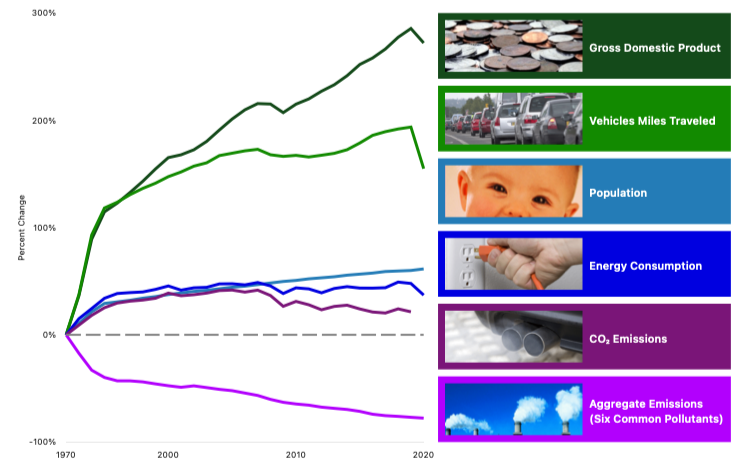
(“Our Nation’s Air,” Environmental Protection Agency, 2021)
The U.S. is a world leader in lowering carbon emissions, largely because of increased use of natural gas for electricity generation. (Matti Rautkivi And Michael Levitin, “How The U.S. Became The Top Climate Leader — Despite Trump’s Denialism,” Time, 12/6/18; “BP Statistical Review of World Energy,” BP, 7/21)
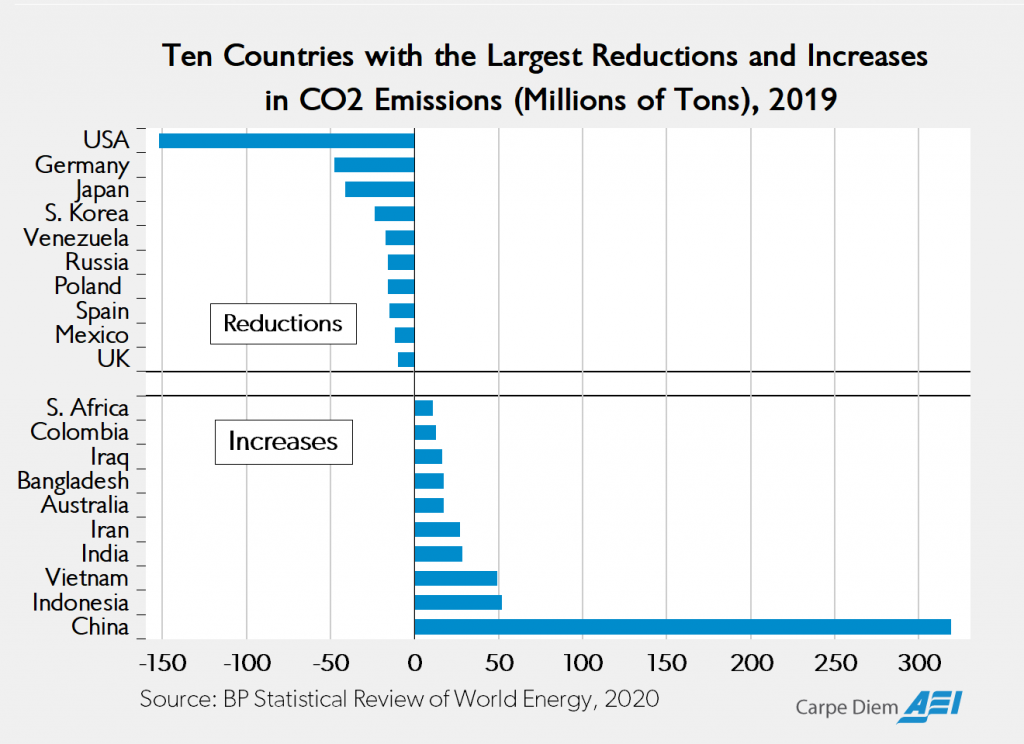
(Mark Perry, “Monday evening links, all chart edition,” American Enterprise Institute, 11/2/20)
In 2017, the surge of natural gas for power generation helped the sector reach a 30-year low for carbon dioxide emissions. (Seth Whitehead, “Report: Power Sector Co2 Emissions At Lowest Levels Since 1988 — Thanks Largely To Natural Gas,” Energy In Depth, 4/4/18)
Natural gas is responsible for two-thirds of the CO2 emission reductions in U.S. electricity generation—double the reductions from renewable sources. (“Emissions of Carbon Dioxide in the Electric Power Sector,” Congressional Budget Office, 12/22)
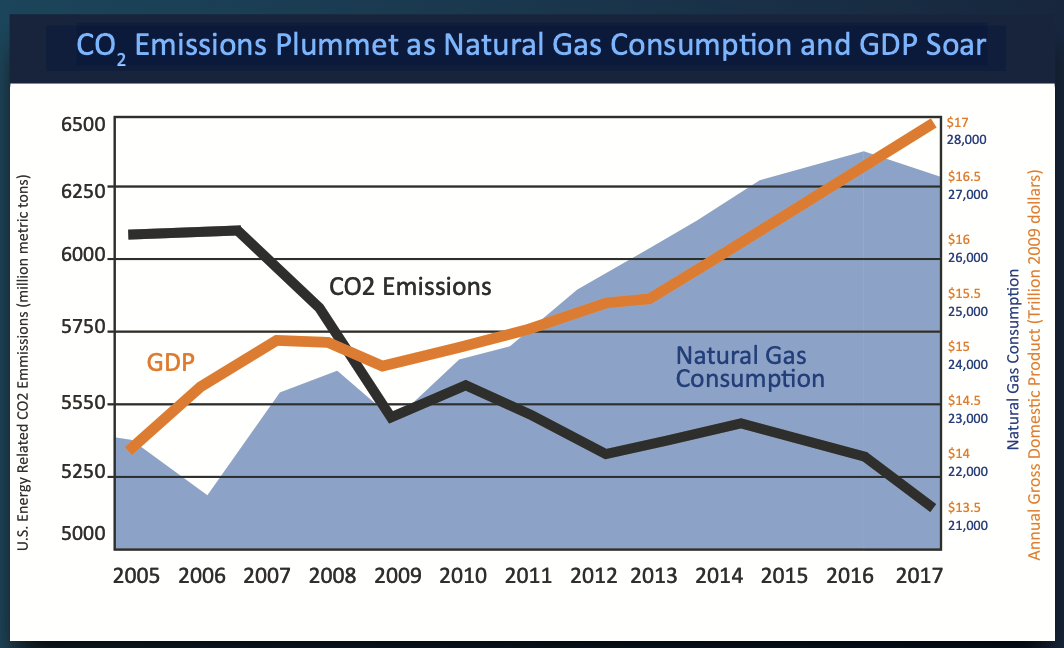
(“Natural Gas: A Boon to the U.S. Economy…and Environment,” Energy In Depth, 4/19/18)
Environmental Impacts Of Solar Energy
Excessive And Damaging Land Use
According to an analysis from The Heartland Institute, replacing power from traditional energy sources with solar power would require 57,048 square miles of land—an area equivalent to the size of New York and Vermont—for 18.8 billion solar panels. “Solar panel farms generate only 1.5 percent of the nation’s electricity and would be an inefficient way to generate the more than eight billion Megawatt hours (MWhrs) of power currently provided by fossil fuels and nuclear for industrial, commercial, and residential uses, as well as automotive transportation. If we use the cutting-edge Nellis Air Force Base solar farm as a model of the power such facilities can produce, we find that to generate the more than eight billion MWhrs each year with solar would require completely blanketing 57,048 square miles of land—an area equivalent to the size of the states of New York and Vermont—with 18.8 billion solar panels. Obviously, this would wreak much havoc on the environment. In 2018, fossil fuels and nuclear generated about 85 percent of 4.2 billion MWhrs of electricity used in the United States, about 3.46 billion MWhrs. Replacing 3.46 billion MWhrs of conventional generation with solar would require 108,125 facilities the size of the one at Nellis Air Force Base. At 140 acres per facility, those solar farms would require 7.8 billion panels covering 15.14 million acres, or 23,652 square miles.17 That’s almost the size of West Virginia. But our estimate doesn’t stop there. Only 35 percent of natural gas is used to generate electricity. The other 65 percent of all natural gas production serves industrial, commercial, and residential needs, including about 62 million homes.18 Replacing this non-electricity natural gas component is equivalent to producing an additional 2.73 billion MWhrs, which would require an additional 6.1 billion solar panels that would blanket 18,648 square miles of land.19” (Paul Driessen, “Protecting the Environment from the Green New Deal,” The Heartland Institute, 12/19)
“Clearing land for construction and the placement of the [solar] power plant may have long-term effects on the habitats of native plants and animals.” “As with any type of power plant, large solar power plants can affect the environment at or near their locations. Clearing land for construction and the placement of the power plant may have long-term effects on the habitats of native plants and animals. However, installing solar energy systems on land with marginal agricultural value or integrating solar energy systems on farms may provide a variety of economic and environmental benefits to farmers.” (“Solar explained: Solar energy and the environment,” U.S. Energy Information Administration, Updated 2/25/22)
A Michigan Technological University survey found that many farmers question what the structures required for solar power will do to the long-term quality of their farmland. As one farmer put it, “I’m concerned too, if you’re pouring a bunch of concrete and putting in permanent structures, what does this look like in the end of 20 or 30 years?” (Alexis S. Pascaris, Chelsea Schelly and Joshua M. Pearce, “A First Investigation of Agriculture Sector Perspectives on the Opportunities and Barriers for Agrivoltaics,” Agronomy, 11/28/20)
Excessive Water Consumption
Solar installation can require large amounts of water “for cleaning solar collectors and concentrators or for cooling turbine generators” that “in some arid locations may affect the ecosystems that depend on these water resources.” “Some solar power plants may require water for cleaning solar collectors and concentrators or for cooling turbine generators. Using large volumes of ground water or surface water for cleaning collectors in some arid locations may affect the ecosystems that depend on these water resources.” (“Solar explained: Solar energy and the environment,” U.S. Energy Information Administration, Updated 2/25/22)
Environmentally Harmful Chemicals And Metals
Solar panels use hazardous chemicals and heavy metals that can be environmentally harmful pollutants if not handled properly both during production and when obsolete solar installations are retired. “There are hazardous chemicals used to make photovoltaic (PV) cells and panels that must be carefully handled to avoid release to the environment. Some types of PV cell technologies use heavy metals, and these types of cells and PV panels may require special handling when they reach the end of their useful life. Some solar thermal systems use potentially hazardous fluids to transfer heat, and leaks of these materials could be harmful to the environment. U.S. environmental laws regulate the use and disposal of hazardous materials. The U.S. Department of Energy is supporting various efforts to address end-of-life issues related to solar energy technologies, including the recovery and recycling of the materials used to manufacture PV cells and panels. Several states have enacted laws that encourage recycling of PV panels.” (“Solar explained: Solar energy and the environment,” U.S. Energy Information Administration, Updated 2/25/22)
Rare earth metals are necessary to build batteries and other technologies for electric vehicles and renewable energy sources like, wind and solar power. (James MacDonald, “The Downside To Renewable Energy, JSTOR Daily, 5/6/19; “U.S. Dependence On China’s Rare Earth: Trade War Vulnerability,” Reuters, 6/27/19)
China produces 60 percent of the world’s rare earths and processes nearly 90 percent, giving the country a near monopoly. “At present China produces 60 percent of the world’s rare earths but processes nearly 90 percent, which means that it is importing rare earths from other countries and processing them. This has given China a near monopoly.” (Gracelin Baskaran, “What China’s Ban on Rare Earths Processing Technology Exports Means,” Center for Strategic and International Studies, 1/8/24)
In the Democratic Republic of the Congo cobalt, another mineral critical to renewable energy and electrical vehicles, mines have been found to be unsafe and employ child labor. And, in China, rare earth mines have poisoned water and soil and caused “cancer villages” in impoverished areas. (Annie Kelly, “Apple and Google named in US lawsuit over Congolese child cobalt mining deaths,” The Guardian, 12/16/19; Alice Su, “The hidden costs of China’s rare-earth trade,” Los Angeles Times, 7/29/19)
Energy Intensive Production
“Solar energy technologies require use of materials, such as metals and glass, that are energy intensive to make” and it can take 1-4 years for a solar system to produce an equivalent amount of energy required for that material production. “Solar energy technologies require materials, such as metals and glass, that are energy intensive to make. The environmental issues related to producing these materials could be associated with solar energy systems. A number of organizations and researchers have conducted PV energy payback analysis and concluded that a PV system can produce energy equivalent to the energy used for its manufacture within 1 to 4 years. Most PV systems have operating lives of up to 30 years or more.” (“Solar explained: Solar energy and the environment,” U.S. Energy Information Administration, Updated 1/19/24)
Dangerous To Wildlife
“In addition, the beam of concentrated sunlight a solar power tower creates can kill birds and insects that fly into the beam.” (“Solar explained: Solar energy and the environment,” U.S. Energy Information Administration, Updated 2/25/22)
Environmental Impacts Of Wind Energy
Excessive And Damaging Land Use
According to an analysis from The Heartland Institute, replacing power from traditional energy sources wind power would require 2.12 million turbines on 500,682 square miles of land—an area equivalent to Arizona, California, Nevada, Oregon, and much of West Virginia. “The Fowler Ridge Wind Farm in Indiana covers 68 square miles, an area larger than Washington, DC. If similar facilities were used to replace all of the country’s fossil fuels and nuclear power, it would require 2.12 million turbines on 500,682 square miles of farm, wildlife habitat, and scenic lands. This would require an amount of land as large as the combined total for Arizona, California, Nevada, Oregon, and much of West Virginia. If all U.S. turbines were capable of generating power at Fowler Ridge’s 2018 output rate, it would take 2,662 Fowler-sized facilities to generate the 3.46 billion MWhrs of electricity needed to replace fossil fuels and nuclear. That would require 207,600 square miles of land and 878,308 turbines.31,32 However, wind turbines would also have to replace the natural gas not used to generate electricity. This is equivalent to 2.7 billion MWhrs of power annually to cover natural gas currently used for industrial, commercial, and residential uses. That would necessitate an additional 692,492 turbines on 163,680 square miles of land.33 Replacing America’s gasoline- and diesel-fueled cars, trucks, and buses with electricity-powered versions would demand another 2 billion MWhrs, and thus another 507,692 turbines on 119,964 square miles of land.34 One week of sufficient battery backup for this electricity generation, to cover windless periods, would require an additional 9,438 square miles of land and 39,971 turbines.35 In sum, replacing fossil fuels and nuclear power with wind generation would necessitate 2.12 million turbines and 500,682 square miles of farm, wildlife habitat, and scenic lands—an amount of land as large as the combined total for Arizona, California, Nevada, Oregon, and much of West Virginia. However, the wind does not blow equally in all parts across the country. Wind turbines on the scale imagined by GND advocates would need to be placed in lessthan-optimal locations, requiring even more turbines.36 Further, there is a 5–10 percent loss of power when electricity travels along long transmission lines, and wind turbines lose about 15 percent of their generating capacity per decade. This would undoubtedly increase the number of turbines and land areas impacted. With these factors in mind, the number of required wind turbines could easily double, to 4.2 million turbines on a land area the size of one-third of the entire lower 48 states. Some wind energy advocates argue each wind turbine would require ‘only’ 50 or 60 acres, though actual real-world experience suggests this is not the case. If larger turbines are installed, fewer would be needed, but each one could need more acreage for proper operation. It would be virtually impossible to power the entire United States using only wind power. It is much more likely that in a United States fueled entirely by renewable energy sources, wind would be one part of a larger mix, one that would include solar and hydropower. However, the scale of land disruption caused by wind turbines would nonetheless be significant.” (Paul Driessen, “Protecting the Environment from the Green New Deal,” The Heartland Institute, 12/19)
“Most wind power projects on land require service roads that add to the physical effects on the environment.” (“Wind explained: Wind energy and the environment,” U.S. Energy Information Administration, Updated 12/17/21)
Energy Intensive Production
“Metals and other materials used to make wind turbine components” can be energy intensive to produce. “Producing the metals and other materials used to make wind turbine components has impacts on the environment, and fossil fuels may have been used to produce the materials.” (“Wind explained: Wind energy and the environment,” U.S. Energy Information Administration, Updated 12/17/21)
Environmentally Harmful Chemicals And Metals
Wind turbine blades cannot be recycled. “Although most of the materials used to make wind turbines can be reused or recycled, turbine blades, as most are currently constructed, cannot be recycled.” (“Wind explained: Wind energy and the environment,” U.S. Energy Information Administration, Updated 12/27/22)
Wind turbines have been known to catch fire and leak lubricating liquids. “A small number of wind turbines have also caught fire, and some have leaked lubricating fluids, but these occurrences are rare.” (“Wind explained: Wind energy and the environment,” U.S. Energy Information Administration, Updated 12/17/21)
Rare earth metals are necessary to build batteries and other technologies for electric vehicles and renewable energy sources like, wind and solar power. (James MacDonald, “The Downside To Renewable Energy, JSTOR Daily, 5/6/19; “U.S. Dependence On China’s Rare Earth: Trade War Vulnerability,” Reuters, 6/27/19)
China has at least 85% of the world’s capacity to process rare earth ores into material manufacturers can use. “China is home to at least 85% of the world’s capacity to process rare earth ores into material manufacturers can use, according to research firm Adamas Intelligence.” (“U.S. Dependence On China’s Rare Earth: Trade War Vulnerability,” Reuters, 6/27/19)
In the Democratic Republic of the Congo—a major source of the rare earth mineral, cobalt—mines have been found to be unsafe and employ child labor. And, in China, mines have poisoned water and soil and caused “cancer villages” in impoverished areas. (Annie Kelly, “Apple and Google named in US lawsuit over Congolese child cobalt mining deaths,” The Guardian, 12/16/19; Alice Su, “The hidden costs of China’s rare-earth trade,” Los Angeles Times, 7/29/19)
Dangerous To Wildlife
Wind turbines can cause bird and bat deaths that “contribute to declines in the population of species also affected by other human-related impacts.” “Some types of wind turbines and wind projects cause bird and bat deaths. These deaths may contribute to declines in the population of species also affected by other human-related impacts. The wind energy industry and the U.S. government are researching ways to reduce the effect of wind turbines on birds and bats.” (“Wind explained: Wind energy and the environment,” U.S. Energy Information Administration, Updated 12/17/21)
Visual And Auditory Effects
“Modern wind turbines can be very large machines, and they may visually affect the landscape.” (“Wind explained: Wind energy and the environment,” U.S. Energy Information Administration, Updated 12/17/21)
“Some people do not like the sound that wind turbine blades make as they turn in the wind.” (“Wind explained: Wind energy and the environment,” U.S. Energy Information Administration, Updated 12/17/21)
Environmental Impacts Of Electric Vehicles
Environmentally Harmful Chemicals And Metals
Lithium mining necessary for EV batteries requires “an immense amount of water is pumped down into salt flats, bringing mineral-rich saltwater to the surface” and can potentially contaminate local water supplies. “The environmental toll of electric car batteries begins before the product is even assembled, most notably in the mining of its active material, lithium. To extract lithium from the Earth, an immense amount of water is pumped down into salt flats, bringing mineral-rich saltwater to the surface. Lithium is filtered out of the mixture left behind after the water evaporates. This water-intensiveness is problematic for several reasons, including its potential to contaminate the water supply.” (Andrew Sheldon, “Are Electric Car Batteries Bad for the Environment?,” Your AAA Today, 4/20/22)
“More than half of the Earth’s lithium supply, however, is in the Lithium Triangle, spanning Andean Mountain sections of Argentina, Bolivia and Chile. The area is one of the driest places on the globe and lithium mining consumes as much as 65% of the region’s water, according to the United Nations.” “Further complicating the issue is the location of these mines, many of which are found in desert regions of Australia and China. More than half of the Earth’s lithium supply, however, is in the Lithium Triangle, spanning Andean Mountain sections of Argentina, Bolivia and Chile. The area is one of the driest places on the globe and lithium mining consumes as much as 65% of the region’s water, according to the United Nations.” (Andrew Sheldon, “Are Electric Car Batteries Bad for the Environment?,” Your AAA Today, 4/20/22)
Cobalt, another mineral necessary for EV batteries, “produces hazardous byproducts that can toxify the environment. Cobalt mine sites often contain sulphur, which generate sulfuric acid when exposed to air and water. This process wreaks havoc on rivers, streams and aquatic life, creating damage that can last for hundreds of years, according to the United Nations.” “Lithium isn’t the only potentially hazardous electric vehicle battery material. The process of mining for cobalt, the majority of which is done in the Democratic Republic of Congo, produces hazardous byproducts that can toxify the environment. Cobalt mine sites often contain sulphur, which generate sulfuric acid when exposed to air and water. This process wreaks havoc on rivers, streams and aquatic life, creating damage that can last for hundreds of years, according to the United Nations.” (Andrew Sheldon, “Are Electric Car Batteries Bad for the Environment?,” Your AAA Today, 4/20/22)
Rare earth metals are necessary to build batteries and other technologies for electric vehicles and renewable energy sources like, wind and solar power. (James MacDonald, “The Downside To Renewable Energy, JSTOR Daily, 5/6/19; “U.S. Dependence On China’s Rare Earth: Trade War Vulnerability,” Reuters, 6/27/19)
China has at least 85% of the world’s capacity to process rare earth ores into material manufacturers can use. “China is home to at least 85% of the world’s capacity to process rare earth ores into material manufacturers can use, according to research firm Adamas Intelligence.” (“U.S. Dependence On China’s Rare Earth: Trade War Vulnerability,” Reuters, 6/27/19)
In the Democratic Republic of the Congo—a major source of the rare earth mineral, cobalt—mines have been found to be unsafe and employ child labor. And, in China, mines have poisoned water and soil and caused “cancer villages” in impoverished areas. (Annie Kelly, “Apple and Google named in US lawsuit over Congolese child cobalt mining deaths,” The Guardian, 12/16/19; Alice Su, “The hidden costs of China’s rare-earth trade,” Los Angeles Times, 7/29/19)
Battery Recycling Challenges
“As little as 5% of the world’s lithium batteries are recycled, according to Chemical and Engineering News, a stark contrast to the 99% of lead car batteries recycled here in the U.S.” “Electric and internal-combustion vehicles have drastically different environmental effects when the cars are in use. But when it comes to recycling, the situation is completely reversed. As little as 5% of the world’s lithium batteries are recycled, according to Chemical and Engineering News, a stark contrast to the 99% of lead car batteries recycled here in the U.S. The dearth of recycled lithium batteries has significant economic repercussions, but it also takes a dire toll on the environment.” (Andrew Sheldon, “Are Electric Car Batteries Bad for the Environment?,” Your AAA Today, 4/20/22)
“Most lithium batteries end up in landfills, where their hazardous components can leak into the soil and groundwater. Landfills are also a major contributor of greenhouse gas emissions, the EPA reports.” (Andrew Sheldon, “Are Electric Car Batteries Bad for the Environment?,” Your AAA Today, 4/20/22)
Lithium battery recycling “takes a lot of time, money and effort.” “Recycling would also limit the need for mining raw materials, an environmentally destructive stage in an electric car battery’s lifespan. So why are so few lithium car batteries recycled? In short, because it takes a lot of time, money and effort.” (Andrew Sheldon, “Are Electric Car Batteries Bad for the Environment?,” Your AAA Today, 4/20/22)
Because lithium batteries “vary in size, shape and component ratios from one manufacturer to another. Each one, therefore, needs to be broken down in a different matter, creating a highly labor- and energy-intensive process.” “Unlike lead batteries, there’s no standardization when it comes to lithium car batteries. They often vary in size, shape and component ratios from one manufacturer to another. Each one, therefore, needs to be broken down in a different matter, creating a highly labor- and energy-intensive process. Making matters worse, battery packs are not designed to be disassembled. They can contain several thousand individual battery cells plus a complex system of circuitry and sensors. All of these components are tight packed together and secured in a plastic or aluminum case. Like other aspects of electric vehicles, lithium battery recycling finds itself stuck in a chicken-and-egg problem. Because of the aforementioned hurdles, governments and private companies have been hesitant to invest in large-scale recycling programs but improving recycling efficiency won’t occur without such efforts.” (Andrew Sheldon, “Are Electric Car Batteries Bad for the Environment?,” Your AAA Today, 4/20/22)
Emissions From Production And Charging
“Research by the European Environment Agency found batteries alone account for 10% to 75% of the energy and 10% to 70% of the greenhouse gas emissions resulting from the entire production of the vehicle.” “Because of methods required to mine for its raw materials, and their subsequent environmental effects, battery production is likely the most environmentally damaging stage in the manufacturing of electric vehicles. Research by the European Environment Agency found batteries alone account for 10% to 75% of the energy and 10% to 70% of the greenhouse gas emissions resulting from the entire production of the vehicle. If you remove the lithium battery from the equation, production of electric and gas-powered vehicles is very similar and thus, have nearly identical effects on the environment. Its inclusion, however, puts electric vehicle manufacturing’s environmental impact over the top.” (Andrew Sheldon, “Are Electric Car Batteries Bad for the Environment?,” Your AAA Today, 4/20/22)
“Production of electric cars emits between 1.3 and 2 times the amount of greenhouse gases than that of internal-combustion vehicles.” “The same EEA study found production of electric cars emits between 1.3 and 2 times the amount of greenhouse gases than that of internal-combustion vehicles.” (Andrew Sheldon, “Are Electric Car Batteries Bad for the Environment?,” Your AAA Today, 4/20/22)
Electric vehicles are only as green as the electricity used to power them, some of which is still produced by coal-fired power plants. Thus, claims of zero emissions are not necessarily accurate. “Critics of electric vehicles are often quick to point out that green vehicles aren’t, in fact, green. They are charged by an electrical grid likely powered by fossil fuels. This is true. Unless the electricity utilized to power an electric car battery is derived entirely from renewable energy, there are emissions associated with it. But electric grids across the country are shifting to a mix of natural gas, wind and solar power.” (Andrew Sheldon, “Are Electric Car Batteries Bad for the Environment?,” Your AAA Today, 4/20/22)